
Fun & Misc Calculators
Zodiac sign finder, dice roller, love calculator, password generator, and random number generator — tools for when math meets fun.
All Fun & Misc Calculators (5)
Click any calculator to open it — all tools are free, instant, and require no sign-up.

Dice Probability — The Math Behind Each Roll
A fair die produces each face with equal probability. The probability of any single outcome on an n-sided die is 1/n. When rolling multiple dice, the outcomes multiply — but the way results combine creates interesting distributions where middle values are more likely than extremes.
Western Zodiac Sign Date Reference
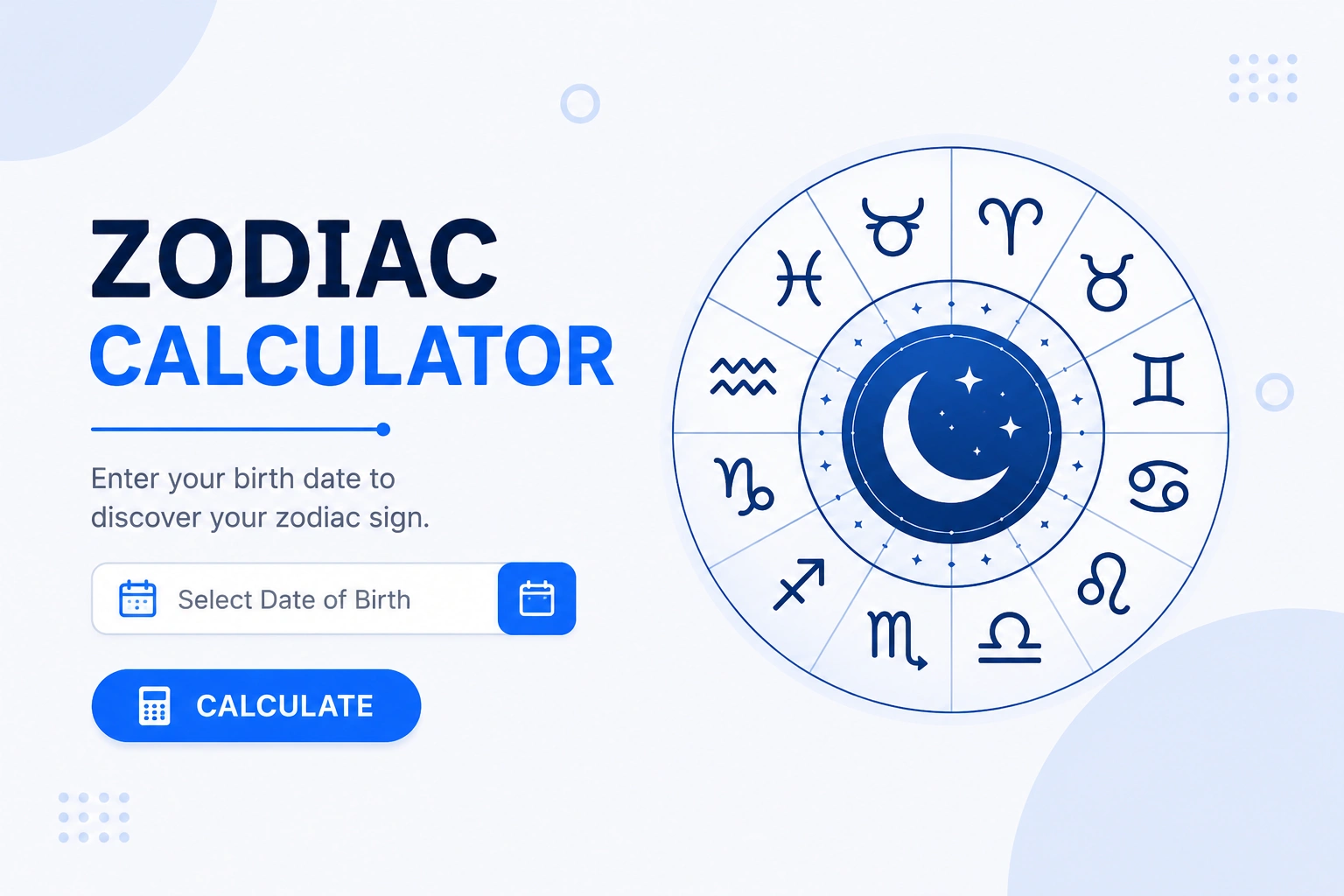
The Western zodiac assigns a sign based on the calendar date you were born. Enter your birthday in the zodiac calculator to get your sign instantly, along with element, ruling planet, personality traits, and Chinese zodiac animal. The full date ranges:
| Sign | Symbol | Dates | Element |
|---|---|---|---|
| Aries | ♈ | Mar 21 – Apr 19 | Fire |
| Taurus | ♉ | Apr 20 – May 20 | Earth |
| Gemini | ♊ | May 21 – Jun 20 | Air |
| Cancer | ♋ | Jun 21 – Jul 22 | Water |
| Leo | ♌ | Jul 23 – Aug 22 | Fire |
| Virgo | ♍ | Aug 23 – Sep 22 | Earth |
| Libra | ♎ | Sep 23 – Oct 22 | Air |
| Scorpio | ♏ | Oct 23 – Nov 21 | Water |
| Sagittarius | ♐ | Nov 22 – Dec 21 | Fire |
| Capricorn | ♑ | Dec 22 – Jan 19 | Earth |
| Aquarius | ♒ | Jan 20 – Feb 18 | Air |
| Pisces | ♓ | Feb 19 – Mar 20 | Water |
Password Strength — The Math of Entropy
Password strength is measured in bits of entropy — the number of bits needed to describe a randomly chosen password from the set of all possible passwords of that length with that character set. More entropy = exponentially harder to crack by brute force.
True Randomness vs Pseudo-Randomness
The random number generator and dice roller on this site use JavaScript's Math.random() — a pseudo-random number generator (PRNG). PRNGs produce sequences that pass statistical randomness tests but are generated deterministically from a seed value. For most uses (games, decisions, samples) this is perfectly adequate. For cryptographic or security purposes, use a cryptographically secure random generator (CSPRNG).
True randomness requires a physical entropy source — radioactive decay, thermal noise, atmospheric noise. Most online tools, including this one, use PRNGs seeded from system time and other sources. The results are uniformly distributed and unpredictable in practice for all everyday uses. Source: RANDOM.ORG — Introduction to Randomness
Chinese Zodiac — 12 Animals and Recent Years
The Chinese zodiac follows a 12-year cycle, each year assigned to one animal. Enter your birth year in the zodiac calculator to find your animal. The cycle runs from the Chinese New Year date (late January or early February) — people born in January or early February may belong to the previous year's animal:
| Animal | Years (every 12 years) | Key Traits |
|---|---|---|
| 🐀 Rat | 1984, 1996, 2008, 2020, 2032 | Clever, adaptable, quick-witted |
| 🐂 Ox | 1985, 1997, 2009, 2021, 2033 | Diligent, dependable, strong |
| 🐅 Tiger | 1986, 1998, 2010, 2022, 2034 | Brave, confident, charismatic |
| 🐇 Rabbit | 1987, 1999, 2011, 2023, 2035 | Gentle, quiet, elegant |
| 🐉 Dragon | 1988, 2000, 2012, 2024, 2036 | Confident, intelligent, ambitious |
| 🐍 Snake | 1989, 2001, 2013, 2025, 2037 | Enigmatic, intuitive, wise |
| 🐎 Horse | 1990, 2002, 2014, 2026, 2038 | Energetic, independent, animated |
| 🐐 Goat | 1991, 2003, 2015, 2027, 2039 | Calm, gentle, creative |
| 🐒 Monkey | 1992, 2004, 2016, 2028, 2040 | Witty, versatile, clever |
| 🐓 Rooster | 1993, 2005, 2017, 2029, 2041 | Observant, hardworking, frank |
| 🐕 Dog | 1994, 2006, 2018, 2030, 2042 | Loyal, honest, kind |
| 🐖 Pig | 1995, 2007, 2019, 2031, 2043 | Compassionate, generous, trusting |
5 Fun Calculator Tips
- The most likely outcome when rolling 2d6 is 7. There are 6 ways to make 7 (1+6, 2+5, 3+4, 4+3, 5+2, 6+1) out of 36 total combinations — a 16.7% probability. This is why 7 is the key number in many board games and why craps is built around it. Rolling 2 or 12 each has only a 1/36 (2.8%) chance. The dice roller shows all individual die values and the total, so you can track these distributions across multiple rolls.
- Longer passwords are more secure than complex short ones. A 16-character password using only lowercase letters (entropy 75.2 bits) takes longer to crack by brute force than a 10-character password using all character types (65.5 bits). Length multiplies the search space exponentially. The password generator defaults to a strong combination of length and character variety — don't reduce the length to make a password "easier to remember."
- The love calculator is for entertainment, not prediction. It uses the names entered as inputs for a deterministic calculation that produces a percentage — the same two names always give the same result. It's a conversation starter and party game, not a relationship test. The zodiac compatibility in the zodiac calculator is based on traditional astrological frameworks, which are cultural traditions rather than scientifically validated predictors.
- For tabletop RPGs, the dice roller supports all standard polyhedral dice. D&D and similar games use d4, d6, d8, d10, d12, and d20. The dice roller supports all of these plus custom dice. The expected value for a d20 is 10.5; rolling with "advantage" (roll twice, keep higher) raises the average to approximately 13.8 — a significant boost for high-stakes checks.
- Use the random number generator for fair draws and selections. Need to pick a random winner from a list of 50 entries? Set range 1–50, generate a number, and the winner is entry number N. Need to shuffle a list randomly? Generate N unique numbers in the 1–N range and use them as positions. The generator produces uniformly distributed results — each number in the range is equally likely. For truly high-stakes selections (legal, financial) consider a certified random service.