
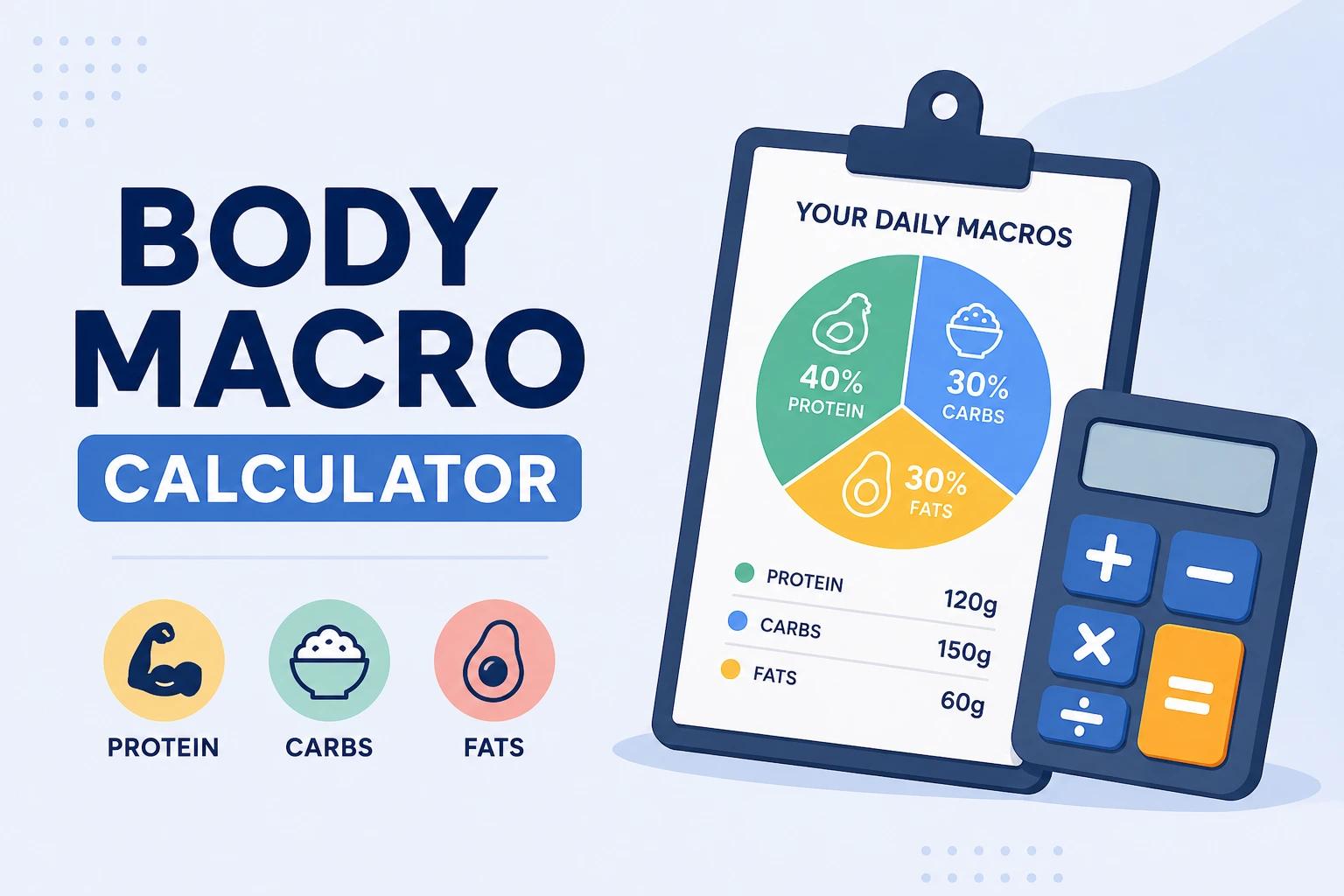
What Is a Macro Calculator?
"Macros" is shorthand for macronutrients — protein, carbohydrates, and fat, the three categories that make up every calorie you eat. A macro calculator takes the same daily calorie target a calorie calculator would give you, then splits it into grams of each, based on your goal and a diet style you choose.
Why split calories at all instead of just counting the total? Because 2,000 calories from mostly protein and vegetables behaves differently in your body than 2,000 calories from mostly refined carbs — for muscle retention, satiety, and blood sugar response, even though the scale might move similarly either way. This tool starts from the same Mifflin-St Jeor equation used by the Academy of Nutrition and Dietetics for estimating energy needs, then applies a goal adjustment and macro split on top.
How to Use This Calculator
- Select sex, age, height, and weight — these drive your baseline metabolic rate
- Choose your activity level — this scales your baseline up to your real daily energy use
- Pick a goal — cutting (fat loss), maintenance, or bulking (muscle gain)
- Pick a diet style — Balanced, High-Protein, or Low-Carb, depending on what you can stick to
- Click "Calculate My Macros" to get your daily calorie target plus grams of protein, carbs, and fat
The Formula
Three steps: estimate maintenance calories, adjust for your goal, then split into grams.
Macros by Goal
Same person, same Balanced style (40/30/30) — only the goal changes. This is the 30-year-old, 165 cm, 65 kg, moderately active example from above:
| Goal | Daily Calories | Protein | Carbs | Fat |
|---|---|---|---|---|
| Cutting (−20%) | 1,699 kcal | 127 g | 170 g | 57 g |
| Maintenance | 2,124 kcal | 159 g | 212 g | 71 g |
| Bulking (+10%) | 2,336 kcal | 175 g | 234 g | 78 g |
Cutting to bulking is a 637-calorie swing (2,336 minus 1,699) at the same body weight and activity level — roughly the calories in a fast-food combo meal. Protein moves the least in absolute terms across goals here because it's a fixed percentage of a moving target; some lifters instead fix protein in grams and only adjust carbs and fat, which keeps muscle-support nutrition constant while the calorie total shifts.
Comparing Diet Styles at the Same Calories
Now hold the goal fixed at Maintenance (2,124 kcal) and change only the diet style — this shows what's actually different between the three options:
| Diet Style | Protein | Carbs | Fat |
|---|---|---|---|
| Balanced (40C/30P/30F) | 159 g | 212 g | 71 g |
| High-Protein (30C/40P/30F) | 212 g | 159 g | 71 g |
| Low-Carb (20C/35P/45F) | 186 g | 106 g | 106 g |
All three rows land on the identical 2,124 calories — fat stays close to constant across the first two styles while protein and carbs essentially swap places. Low-Carb is the outlier: it pulls carbs down to half of the Balanced amount and redirects that gap mostly into fat, since fat carries more than double the calories per gram of carbs or protein.
Macros at Common Calorie Levels
Already know your calorie target from elsewhere, or just want a quick reference without entering your details? Here's the Balanced split (40/30/30) across a range of common daily calorie levels:
| Daily Calories | Protein | Carbs | Fat |
|---|---|---|---|
| 1,500 kcal | 112 g | 150 g | 50 g |
| 1,800 kcal | 135 g | 180 g | 60 g |
| 2,100 kcal | 158 g | 210 g | 70 g |
| 2,400 kcal | 180 g | 240 g | 80 g |
| 2,700 kcal | 202 g | 270 g | 90 g |
| 3,000 kcal | 225 g | 300 g | 100 g |
Protein and Body Weight
A common shorthand in strength training circles is roughly 1 gram of protein per pound of body weight. For the 65 kg (143 lbs) example used throughout this page, that guideline lands at 143 g — close to, but not identical to, the 170 g the High-Protein cutting split above calculates from percentages. Neither number is wrong; the bodyweight guideline is a simpler rule of thumb, while the percentage method scales with total calories instead of body weight alone.
Research reviewed by the Academy of Nutrition and Dietetics generally supports 0.7-1g of protein per pound of body weight for people strength training while in a calorie deficit, which covers both numbers above within a reasonable range. If your calculated protein target falls noticeably outside that band — say, well under 0.6g/lb on an aggressive cut — it's worth manually adjusting the diet style toward High-Protein rather than accepting the default split.
6 Tips for Hitting Your Macros
- Prioritize protein first, then fill in carbs and fat. Hitting 159-212g of protein (the range across styles above) matters more for body composition than getting carbs and fat exactly on target every day.
- A 5-10g miss on any macro most days isn't a failure. Precision tracking has diminishing returns — being within 10g of a 170g protein target (about 40 calories) makes no meaningful difference over weeks.
- Recalculate when your weight changes by 10+ lbs. Since the target scales off current body weight, someone dropping from 65kg to 59kg would see maintenance TDEE fall by roughly 60 calories from the weight change alone, before even accounting for the lower BMR that comes with less body mass.
- Fat below 20% of calories long-term can affect hormone production. Even on Low-Carb (45% fat here), don't drop fat percentage much below the 20-25% range for extended periods — essential fatty acids and fat-soluble vitamin absorption depend on adequate dietary fat.
- Fiber counts toward your carb total but behaves differently. A 212g carb target that's mostly refined starch hits blood sugar harder than the same 212g split across vegetables, legumes, and whole grains, even though both count identically toward the gram target.
- Weekly averages matter more than daily perfection. If Tuesday runs 200 calories over and Wednesday runs 200 under, the week nets out — logging consistently over 7 days reveals patterns that a single day's numbers can hide.