
Unit Converters
Length, weight, temperature, volume, speed, data storage — live bidirectional conversion with all units on screen. Plus IP subnet and length converters.
All Unit Converters (3)
Click any converter to open it — all tools are free, instant, and require no sign-up.

Length Conversion — Metric and Imperial Reference
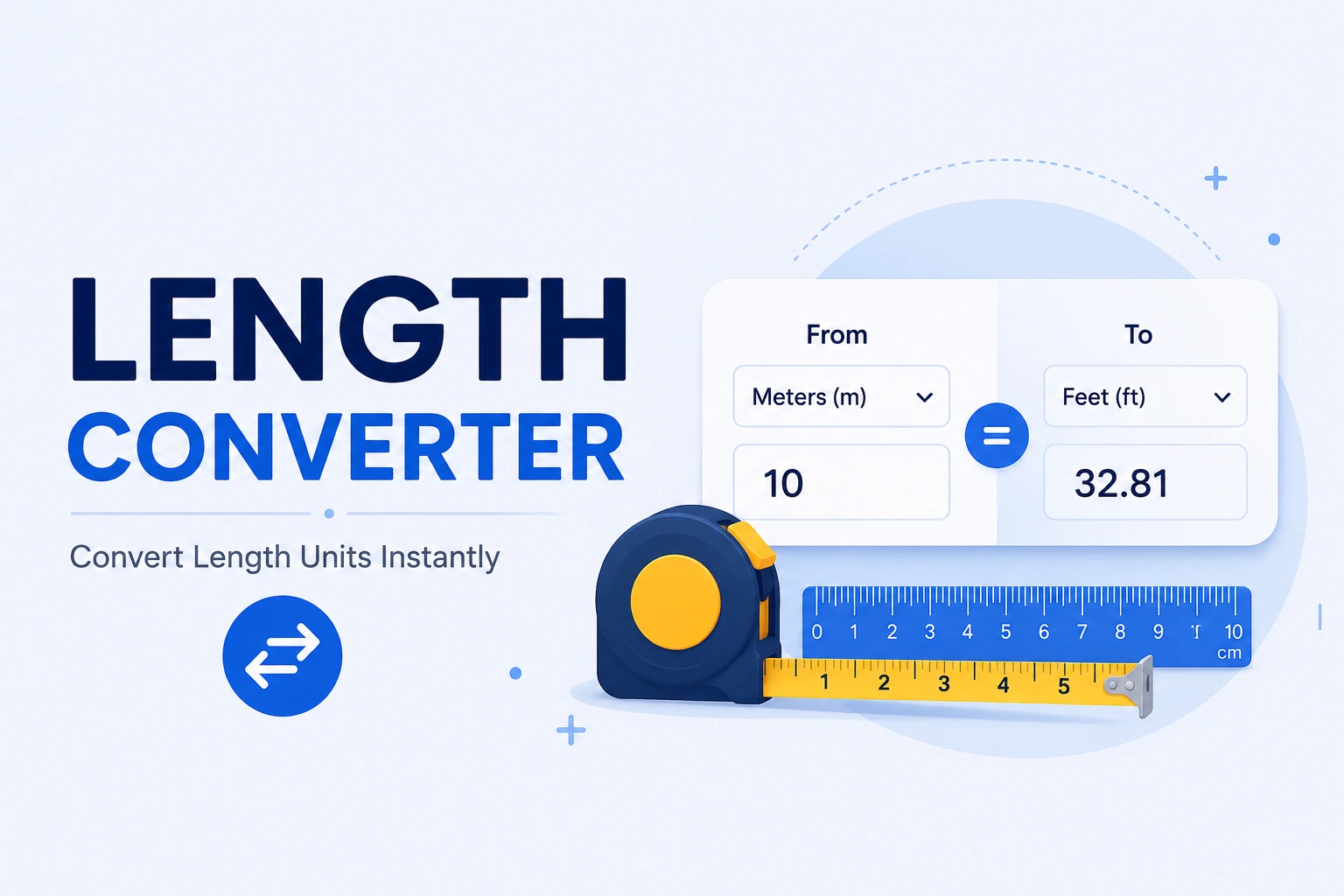
The metric system (millimeters, centimeters, meters, kilometers) and the imperial/US customary system (inches, feet, yards, miles) are the two most commonly used length measurement frameworks. All conversion factors below are exact or rounded to 6 significant figures — the same values used in the conversion calculator.
| From | To | Multiply By | Example |
|---|---|---|---|
| 1 km | miles | 0.621371 | 5 km = 3.10686 mi |
| 1 mile | km | 1.60934 | 10 mi = 16.0934 km |
| 1 meter | feet | 3.28084 | 100 m = 328.084 ft |
| 1 foot | cm | 30.48 | 6 ft = 182.88 cm |
| 1 inch | cm | 2.54 | 12 in = 30.48 cm |
| 1 meter | inches | 39.3701 | 2 m = 78.7402 in |
| 1 meter | yards | 1.09361 | 50 m = 54.6807 yd |
Weight Conversion — Key Reference Values
The kilogram is the base unit of mass in the SI (International System of Units). The pound and ounce are the primary imperial units used in the United States. All values below are calculated from the exact international definition: 1 pound = 0.45359237 kg exactly.
| From | To | Multiply By | Example |
|---|---|---|---|
| 1 kg | pounds (lb) | 2.20462 | 70 kg = 154.324 lb |
| 1 lb | kg | 0.453592 | 150 lb = 68.039 kg |
| 1 kg | ounces (oz) | 35.274 | 1 kg = 35.274 oz |
| 1 oz | grams (g) | 28.3495 | 16 oz = 453.592 g |
| 1 metric ton | kg | 1,000 | 2.5 t = 2,500 kg |
| 1 US ton | lb | 2,000 | 1 ton = 2,000 lb |
Temperature Conversion Formulas
Unlike length and weight, temperature conversion is not a simple multiplication — it requires both multiplication and addition because the scales have different zero points. The three scales in common use are Celsius (metric, water freezes at 0°), Fahrenheit (US customary, water freezes at 32°), and Kelvin (absolute scale, used in science).
IP Subnet Calculator — How CIDR Notation Works
CIDR (Classless Inter-Domain Routing) notation expresses an IP address and its subnet mask as a single value — for example, 192.168.1.0/24. The number after the slash tells you how many bits are used for the network portion, which determines how many host addresses are available.
Data Storage Unit Conversion
Data storage units follow a binary-based system where each step up multiplies by 1,024 (2¹⁰), not 1,000 as in the metric system. This is why a "1 GB" hard drive formatted in a computer shows slightly less than 1 GB — hard drive manufacturers use 1 GB = 1,000,000,000 bytes (decimal), while operating systems use 1 GB = 1,073,741,824 bytes (binary).
| Unit | Abbreviation | Binary Value | Bytes |
|---|---|---|---|
| Kilobyte | KB | 2¹⁰ | 1,024 |
| Megabyte | MB | 2²⁰ | 1,048,576 |
| Gigabyte | GB | 2³⁰ | 1,073,741,824 |
| Terabyte | TB | 2⁴⁰ | 1,099,511,627,776 |
Common quick references: 1 GB = 1,024 MB = 1,048,576 KB. 1 TB = 1,024 GB. 1 MB = 1,048,576 bytes. Source: NIST — SI Prefixes
5 Unit Conversion Tips
- For km to miles, multiply by 0.6 for a quick estimate. The exact factor is 0.621371, so multiplying by 0.6 gives a result about 3% low — close enough for most navigation needs. For 50 km: 50 × 0.6 = 30 mi (actual: 31.07 mi). To go miles to km, multiply by 1.6 (exact: 1.60934) — 20 mi × 1.6 = 32 km (actual: 32.19 km).
- 1 inch = 2.54 cm is an exact definition, not an approximation. Since 1959, the international inch has been defined as exactly 2.54 centimeters. This means all inch-to-metric conversions are exact values, not measured approximations. The foot (30.48 cm), yard (91.44 cm), and mile (1,609.344 m) are all derived from this exact definition.
- −40° is the only temperature where Celsius and Fahrenheit are equal. This isn't a coincidence — it's a mathematical consequence of the two formulas crossing at that point. Verify: °F = (−40 × 9/5) + 32 = −72 + 32 = −40°F. Useful as a sanity check when working with temperature conversions at extreme values.
- For CIDR subnets, the /prefix tells you exactly how many bits are fixed. A /24 network fixes 24 bits, leaving 8 bits for hosts: 2⁸ = 256 addresses, minus 2 reserved = 254 usable. A /22 fixes 22 bits, leaving 10 bits: 2¹⁰ = 1,024 − 2 = 1,022 usable hosts. Each step down in prefix (e.g., /24 to /23) exactly doubles the number of available addresses.
- Hard drive "GB" and computer "GB" are different numbers. When a manufacturer advertises a 1 TB drive, they mean 1,000,000,000,000 bytes (decimal). Your operating system shows it as approximately 931 GB because it uses 1 TB = 1,099,511,627,776 bytes (binary). The 7% difference is not missing data — it's a difference in how the same byte count is expressed in decimal vs binary units. The data storage converter uses binary (1 GB = 1,024 MB) which matches how operating systems report storage.