
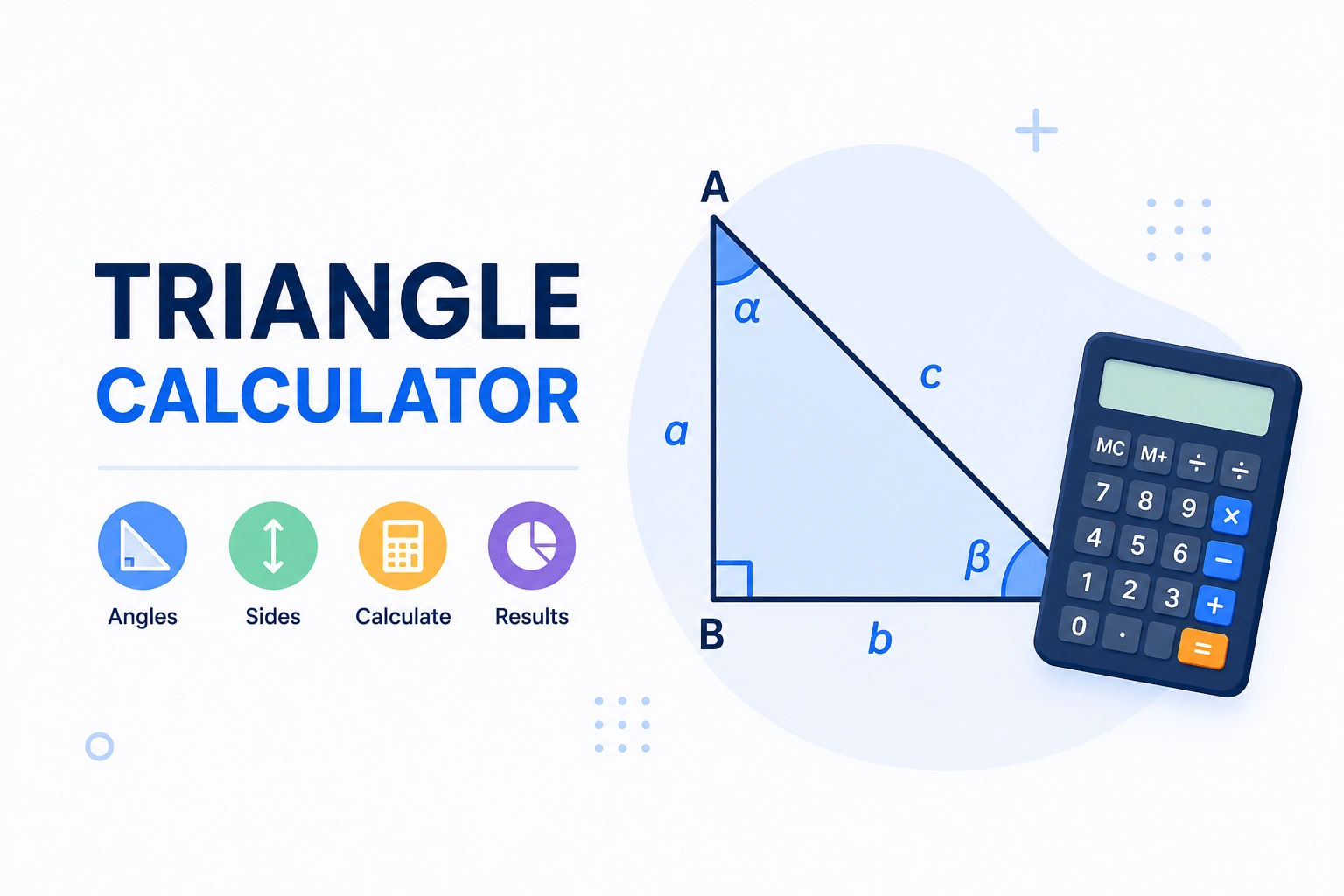
What Is a Triangle Calculator?
A triangle calculator finds all unknown properties of a triangle — area, perimeter, angles, heights, inradius, and circumradius — from whatever combination of sides and angles you already know. Every triangle is fully determined once you provide three independent measurements, as long as at least one of them is a side length.
This calculator supports five input modes: SSS (all three sides), SAS (two sides and the included angle), ASA (two angles and the included side), AAS (two angles and a non-included side), and Right Triangle (any two known values from legs, hypotenuse, and angles). Each mode applies the appropriate formula — Law of Cosines for SSS and SAS, Law of Sines for ASA and AAS, and the Pythagorean theorem for right triangles.
How to Use This Calculator
- Select a mode based on what you know — SSS if you have all three sides, SAS if you have two sides and the angle between them, ASA for two angles and the side between them, AAS for two angles and a non-adjacent side, or Right Triangle if you know it's a right triangle
- Enter your known values — sides in any consistent unit (cm, m, inches, feet), angles in degrees
- Click "Calculate Triangle" to see all results: area, perimeter, all three angles, all three heights, inradius, and circumradius
- The diagram draws your triangle to scale with labeled sides and angles
Triangle Formulas — All Methods
Triangle Types and Their Properties
Every triangle falls into categories based on its sides and angles. Knowing the type immediately tells you useful properties before any calculation:
| Type | Definition | Key Property | Example |
|---|---|---|---|
| Equilateral | All 3 sides equal | All angles = 60°; area = (√3/4)×a² | a=b=c=6 → Area 15.5885 |
| Isosceles | 2 sides equal | Base angles are equal | a=b=5, c=8 → Area 12.0000 |
| Scalene | All sides different | All angles different | 7-10-13 → Area 34.6410 |
| Right | One angle = 90° | c² = a²+b²; hyp = longest side | 3-4-5 → Area 6.0000 |
| Obtuse | One angle > 90° | Longest side opposite obtuse angle | 2-3-4 → obtuse at C |
| Acute | All angles < 90° | All altitudes fall inside triangle | 5-6-7 → all angles acute |
Heron's Formula — Area from Three Sides
Named after Heron of Alexandria (~60 CE), this formula finds area knowing only the three side lengths — no angles, no height measurement needed. It works by first computing the semi-perimeter s, then plugging into a single square root expression:
Heron's formula gives exact results for any triangle without needing a height measurement — which is why it's used in surveying and CAD software where side lengths come from distance measurements. Reference: Khan Academy — Heron's Formula
Triangle Reference Table
All six rows below are individually calculated using Heron's formula and the Law of Cosines — no row is estimated from another:
| Triangle | Sides (a-b-c) | Area | Perimeter | Largest Angle |
|---|---|---|---|---|
| 3-4-5 Right | 3 – 4 – 5 | 6.0000 | 12 | 90.00° |
| 5-12-13 Right | 5 – 12 – 13 | 30.0000 | 30 | 90.00° |
| 8-15-17 Right | 8 – 15 – 17 | 60.0000 | 40 | 90.00° |
| Equilateral (s=6) | 6 – 6 – 6 | 15.5885 | 18 | 60.00° |
| Isosceles 5-5-8 | 5 – 5 – 8 | 12.0000 | 18 | 106.26° |
| Scalene 7-10-13 | 7 – 10 – 13 | 34.6410 | 30 | 97.18° |
Pythagorean Triples — Integer Right Triangles
A Pythagorean triple is a set of three positive integers (a, b, c) satisfying a²+b²=c². These produce right triangles with exact integer measurements — no decimals. The 3-4-5 triangle is the smallest; here are the common ones used in construction, carpentry, and engineering:
| Triple (a-b-c) | Area | Perimeter | Angle A | Angle B | Verify: a²+b²=c² |
|---|---|---|---|---|---|
| 3 – 4 – 5 | 6 | 12 | 36.87° | 53.13° | 9+16 = 25 ✓ |
| 5 – 12 – 13 | 30 | 30 | 22.62° | 67.38° | 25+144 = 169 ✓ |
| 8 – 15 – 17 | 60 | 40 | 28.07° | 61.93° | 64+225 = 289 ✓ |
| 7 – 24 – 25 | 84 | 56 | 16.26° | 73.74° | 49+576 = 625 ✓ |
| 20 – 21 – 29 | 210 | 70 | 43.60° | 46.40° | 400+441 = 841 ✓ |
The 3-4-5 triple is widely used in construction to establish a perfect right angle: measure 3 units along one wall, 4 units along another, and if the diagonal between those two endpoints is exactly 5 units, the corner is square. Reference: NIST — Measurement Standards | Khan Academy — Pythagorean Theorem
5 Tips for Triangle Calculations
- When you only have three sides, always use Heron's formula for area. You don't need to find any angle first. For sides 7-10-13: s=15, area = √(15×8×5×2) = √1200 = 34.6410. Trying to first find an angle using the Law of Cosines and then computing area from ½ × base × height works too, but introduces an extra rounding step that Heron's avoids entirely.
- The inradius tells you the largest circle that fits inside the triangle. For the 3-4-5 triangle, inradius = 1.0000 — a circle of radius exactly 1 fits perfectly inside, tangent to all three sides. Formula: r = Area / s. For the equilateral triangle with side 6, inradius = 1.7321 (= side/(2√3)).
- The circumradius is half the hypotenuse in any right triangle. For the 3-4-5 triangle, circumradius = 2.5000 = 5/2. This is always true: in a right triangle, the circumscribed circle has the hypotenuse as its diameter, making circumradius = hypotenuse ÷ 2. Quick check for any claimed right triangle: if circumradius ≠ hypotenuse/2, it's not actually a right triangle.
- For scalene triangles with all sides known, verify inputs satisfy the triangle inequality before computing. Each side must be strictly less than the sum of the other two. For sides 2-3-7: 2+3=5 < 7 — invalid. For sides 5-12-13: 5+12=17 > 13, 5+13=18 > 12, 12+13=25 > 5 — all three conditions met, valid triangle.
- Angles always sum to exactly 180° — use this to catch rounding errors. After computing angles with the Law of Cosines (e.g., A=36.8699°, B=53.1301°), angle C = 180 - 36.8699 - 53.1301 = 90.0000° exactly. If your three computed angles don't sum to 180.0000°, a rounding error crept in somewhere. The calculator uses this check internally to ensure consistency.