
Health Calculators
BMI, BMR, body fat, calorie needs, macros, ideal weight, and pregnancy — science-backed health tools with verified formulas and plain-language explanations.
All Health Calculators (7)
Click any calculator to open it — all tools are free, instant, and require no sign-up.


BMI — What It Measures and What It Doesn't
Body Mass Index (BMI) is calculated by dividing weight in kilograms by the square of height in meters. It gives a single number that places a person into one of four WHO categories. It's fast and requires no equipment, which is why it's widely used — but it doesn't distinguish between muscle and fat.
BMR vs TDEE — The Difference and Why It Matters
BMR (Basal Metabolic Rate) is the number of calories your body burns at complete rest — the energy needed to keep your heart beating, lungs breathing, and organs functioning. TDEE (Total Daily Energy Expenditure) multiplies BMR by an activity factor to estimate total daily calorie burn including movement and exercise.
Body Fat Percentage — Reference Ranges
Body fat percentage is a more accurate indicator of fitness than BMI because it distinguishes fat mass from lean mass (muscle, bone, organs, water). The US Navy circumference method used in the body fat calculator is accurate to within about 3–4% of DEXA scan results for most people.
| Category | Men | Women |
|---|---|---|
| Essential Fat | 2–5% | 10–13% |
| Athletes | 6–13% | 14–20% |
| Fitness | 14–17% | 21–24% |
| Average | 18–24% | 25–31% |
| Obese | 25%+ | 32%+ |
Example outputs from the US Navy formula: a man with waist 85 cm, neck 38 cm, height 175 cm gives 16.9% (Fitness range). A woman with waist 80 cm, hip 95 cm, neck 33 cm, height 165 cm gives 29.4% (Average range). Source: Human Performance Resource Center — Body Fat
Ideal Weight — Four Formulas Compared
There is no single universally agreed ideal weight. The ideal weight calculator uses four medical formulas developed between 1964 and 1983, each derived from different patient populations. For a male of 175 cm (5'9") the four formulas produce:
| Formula | Year | Result (175 cm / 5'9" Male) | Base + Per cm over 152 cm | Base + Per inch over 5 ft |
|---|---|---|---|---|
| Devine | 1974 | 70.7 kg | 50 kg + 0.91 kg/cm | 50 kg + 2.3 kg/inch |
| Robinson | 1983 | 69.1 kg | 52 kg + 0.75 kg/cm | 52 kg + 1.9 kg/inch |
| Miller | 1983 | 68.9 kg | 56.2 kg + 0.56 kg/cm | 56.2 kg + 1.41 kg/inch |
| Hamwi | 1964 | 72.3 kg | 48 kg + 1.06 kg/cm | 48 kg + 2.7 kg/inch |
The average across the four formulas is 70.2 kg for a 175 cm (5'9") male. The base height is 152 cm (5 ft 0 in) — add the per-cm (or per-inch) value for every centimetre (or inch) of height above that. These formulas were originally developed for drug dosing calculations — not aesthetic targets — and do not account for muscle mass, bone density, or body frame size.
Macros — How Protein, Carbs, and Fat Are Split
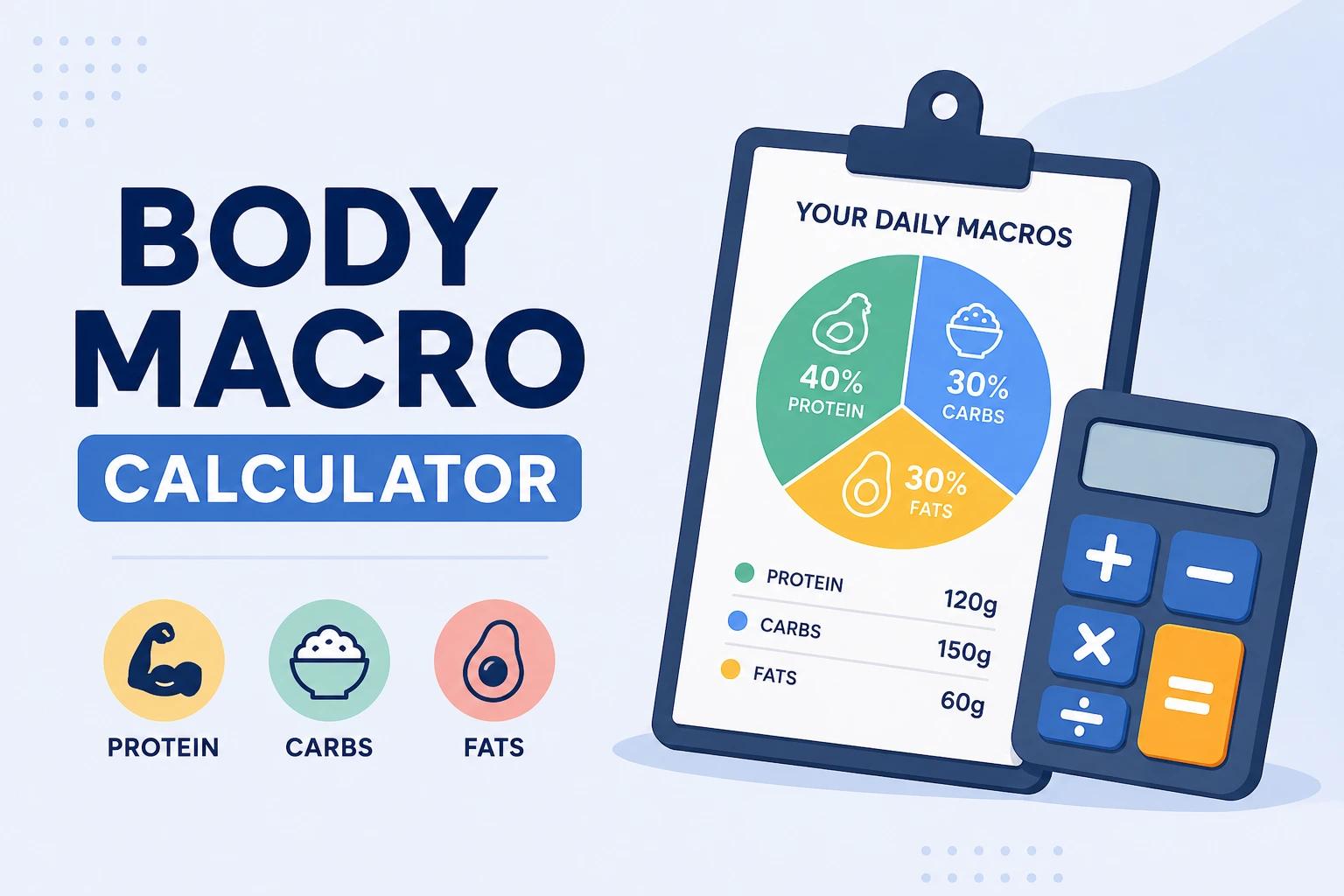
Macronutrients provide all dietary calories: protein and carbohydrates at 4 kcal/gram, fat at 9 kcal/gram. The macro calculator starts from your TDEE and splits calories based on your goal — fat loss, maintenance, or muscle gain — using percentage targets that shift protein up for muscle-focused goals.
Pregnancy Calculator — Due Date and Key Milestones
The pregnancy calculator estimates your due date (EDD — Estimated Due Date) and tracks trimester milestones from either your Last Menstrual Period (LMP) or a known conception date. A standard pregnancy is 40 weeks (280 days) from the first day of the last menstrual period, based on the Naegele's Rule used by healthcare providers worldwide.
| Trimester | Weeks | Key Development | Common Checkups |
|---|---|---|---|
| First | 1–12 | Organ formation, heartbeat develops (week 6) | First prenatal visit, blood tests, dating scan |
| Second | 13–26 | Movement felt, gender visible, rapid growth | Anatomy scan (week 20), glucose screen |
| Third | 27–40 | Lung maturation, weight gain, positioning | Weekly visits from week 36, GBS test |
The pregnancy calculator also shows gestational age if you enter a known conception date — useful when the LMP date is uncertain. Gestational age from conception is typically 2 weeks less than gestational age from LMP, since ovulation usually occurs around day 14 of the cycle. Source: ACOG — Methods for Estimating the Due Date
5 Health Calculation Tips
- BMI is a screening tool, not a diagnosis. A BMI of 26.1 (overweight range) for an 80 kg person at 1.75 m tells you nothing about whether that weight is muscle or fat. Athletes routinely fall in the "overweight" BMI category despite low body fat. Use BMI alongside body fat percentage for a more complete picture.
- Weigh yourself consistently for meaningful tracking. Body weight fluctuates 1–3 kg day-to-day from water, food, and digestive contents. For tracking real change, weigh yourself at the same time each day (typically morning, after bathroom, before food) and use a 7-day rolling average — not single-day readings.
- Protein is the most filling macronutrient per calorie. Among the three macros, protein has the highest thermic effect (about 20–30% of its calories are used in digestion) and the strongest effect on satiety hormones. Most research supports 1.6–2.2 g of protein per kg of body weight per day for muscle preservation during a calorie deficit.
- The 3,500 calorie rule for fat loss is an approximation. It holds reasonably well for short-term predictions but overstates results over months — the body adapts by reducing non-exercise activity and lowering BMR as weight drops. Recalculate your BMR and TDEE every 4–6 weeks as your weight changes to keep calorie targets accurate.
- Body fat measurement methods differ substantially in accuracy. DEXA scan is the gold standard (error ±1–2%). Hydrostatic weighing and Bod Pod are accurate (±2–3%). Bioelectrical impedance scales vary widely (±4–8% depending on hydration). The US Navy tape measure method (used in the body fat calculator) runs ±3–4% — accurate enough for tracking trends over time but not for precise body composition analysis.